How much would Brits pay to unlock in-car technology? | Quotezone
13/10/2026



Reviewed by: Greg Wilson
Founder & Insurance Expert
Written by: Katie Gawley
Insurance Content Writer
Fact-checked by: Quotezone Editorial Team
This content follows our Editorial Guidelines
Last Updated: October 2026
Read time: 15 min
The Hidden Cost of Modern Cars: How much would Brits pay to unlock in-car technology?
There are 34.5 million licensed cars in the UK, accounting for 81% of vehicles on the road. [1] Of these, fully electric vehicles account for 4.8% (1.6 million). [1]
Electric cars were first introduced in the UK in around 1832, [2] and with this the world of motoring changed forever. But despite this, it’s likely that the ban on the sale of new petrol and diesel cars won’t take place until 2035. [3]
But is this technology always welcomed by the public? We surveyed 1,016 UK adults to understand their views on new vehicle technology, specifically in instances when car manufacturers withhold certain in-car features, requiring a paid subscription to unlock, despite the hardware already being fitted.
Key findings:
- Over a third (33.4%) said they find it unreasonable for manufacturers to charge extra for any additional in-car features.
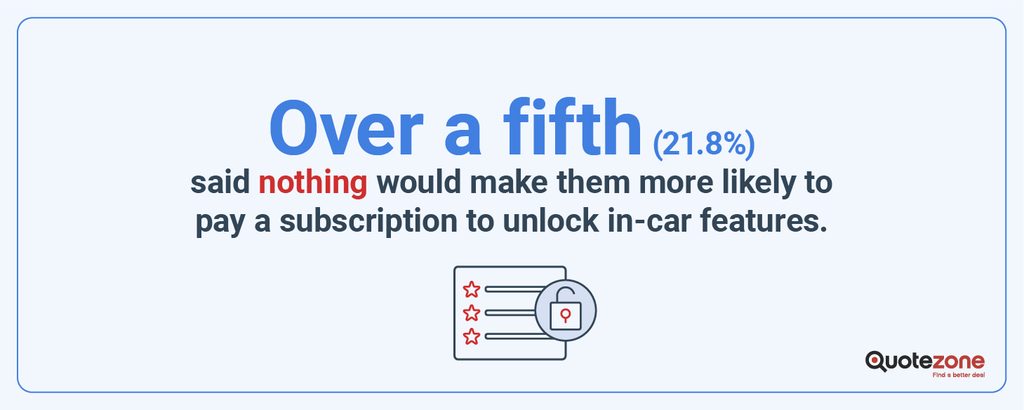
- Over a fifth (21.8%) said nothing would make them more likely to pay a subscription to unlock in-car features.
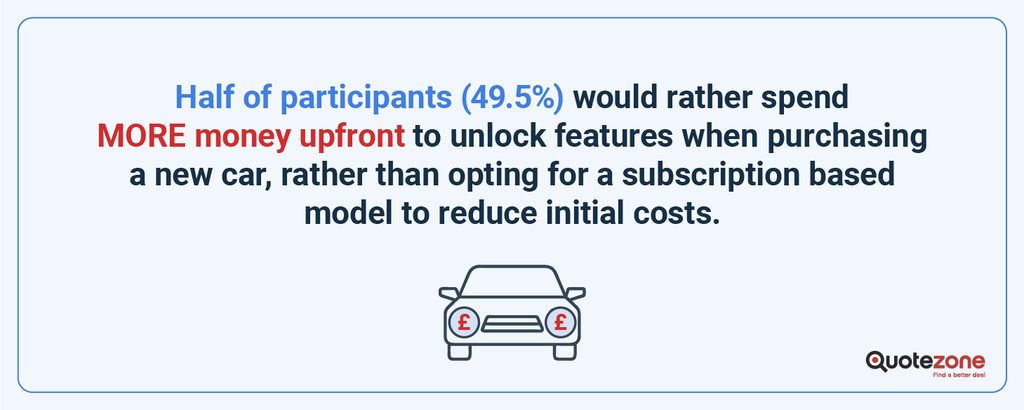
- Almost half of participants (49.5%) would rather spend more money upfront to unlock features, than opting for a subscription based model.
- Almost two in five (38.8%) think touchscreens and car technology can be dangerous because it takes attention away from the road.
- 17.7% of participants find car technology annoying or unnecessarily complicated, with 55-64 year-olds experiencing the most frustration.
- 18.4% said they would prefer their next car to feature mostly traditional physical buttons and switches.
- One in six (15%) have disabled a warning or alert in their car.
How fair is it for manufacturers to charge for pre-fitted hardware?
The survey asked participants how fair they considered it for vehicle manufacturers to charge additionally for features when the hardware had already been fitted.
Just 4.9% said they considered this to be very fair, while the general consensus leant towards participants considering this to either be fairly unfair (37.5%) or very unfair (32.7%).

By age, it appears the older generation believed this to be most unfair, with 39.2% of those aged 55-64 stating they would find this to be very unfair, compared to just 18.2% of the 18-24 age group. In comparison, among the youngest generation (18-24), 13.6% said they actually found this to be very fair. Whereas just 0.7% of those aged 55-64 said the same.

Over a third (34.3%) are much less likely to buy a car if a monthly subscription was required to unlock features
Alongside finding out participants’ opinions towards manufacturers charging additional fees for features, the survey delved into how this might affect consumer behaviour.
When asked whether they would be less likely to buy a car that already had the hardware fitted for a feature but you had to pay a monthly subscription to use it, over a third (34.3%) said they would be much less likely to purchase. In addition to this, 40.6% said they would be slightly less likely to purchase it.
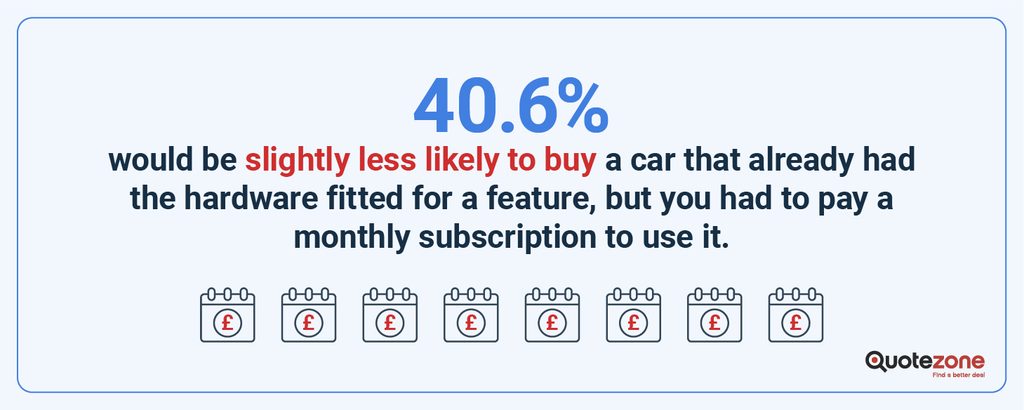
On the other hand, 1.3% said they would actually be much more likely to purchase the car and 19.3% said it would make no difference to them.
It was the older generation who again stood out for being against additional charges after purchasing a car. 42.1% of the 55-64 age group said this would make them much less likely to purchase the car, compared to just 25% of those aged 18-24.
Which car features are considered reasonable to pay extra for?
Although so far, the survey has shown that generally attitudes towards additional charges in vehicles are somewhat negative, we also wanted to uncover which features would be considered acceptable to be charged additionally for.
| Rank | Car feature | Percentage of participants who think it’s reasonable to be charged for |
| 1 | In-car WiFi | 36.0% |
| 2 | None of these | 33.4% |
| 3 | Navigation services | 20.7% |
| 4 | Live traffic announcements | 20.4% |
| 5 | Advanced driver-assistance features | 15.6% |
| 6 | Remote functions through a smartphone app | 14.4% |
| 7 | Advanced vehicle information services | 13.6% |
| 8 | Music or entertainment features | 13.3% |
| 9 | Extra EV charging/range-related services | 12.6% |
| 10 | Extra engine/performance power | 11.8% |
| 11 | Heated seats | 9.4% |
| 12 | Heated steering wheel | 6.9% |
| 13 | All of these | 1.0% |
The highest percentage of participants (36%) said they believed it was reasonable for a car manufacturer to charge a monthly subscription for in-car WiFi. It’s reported most modern vehicles now offer some form of WiFi. [4]
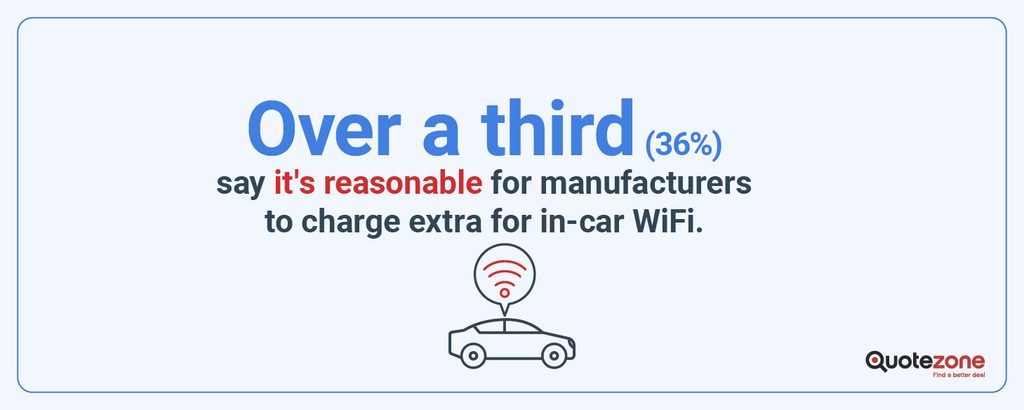
Interestingly, the second highest percentage (33.4%) stated that they would find none of the features reasonable to pay extra for.
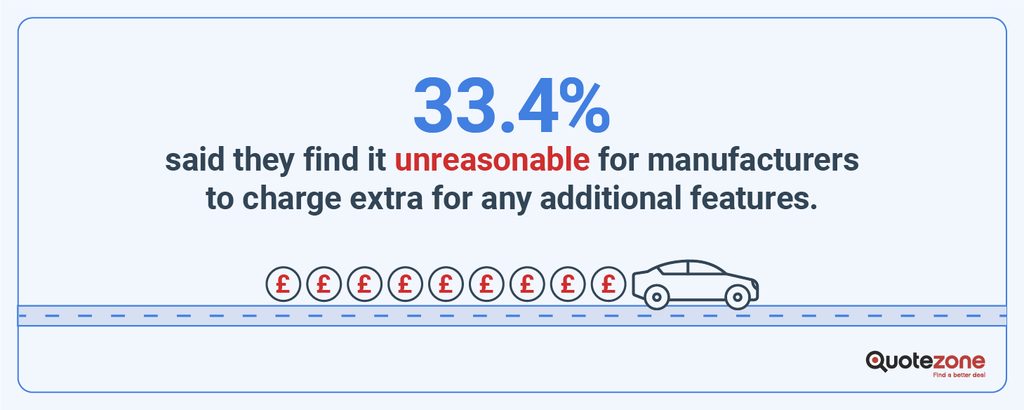
Just over one in ten (11.4%) 18-24 year-olds said they didn’t find it reasonable to pay for any of the features listed, compared to almost half (45.4%) of 55-64 year-olds.
A fifth (20.7%) said they think it’s reasonable to be charged extra for navigation services and just slightly less (20.4%) said they think it’s reasonable to be charged for live traffic announcements.
Just 9.4% said they would find it reasonable to be charged for heated seats and even less (6.9%) said they would find it reasonable to be charged for a heated steering wheel.
This insight comes amidst widespread controversy regarding BMW’s decision to cancel their heated seat subscription model, despite still charging for features such as driving assistance, parking services and navigation updates. [5]
How much would Brits be willing to pay for additional car features?
Alongside discovering which features participants think is reasonable to be charged for, the survey asked them how much they would be willing to pay to have each feature unlocked in a car.
| Rank | Car feature | Average monthly payment |
| 1 | In-car WiFi | £3.09 |
| 2 | Extra engine/performance power | £2.80 |
| 3 | Advanced driver-assistance features | £2.57 |
| 4 | Navigation services | £2.47 |
| 5 | Extra EV charging/range-related services | £2.21 |
| 6 | Live traffic announcements | £2.00 |
| 7 | Heated seats | £1.97 |
| 8 | Music or entertainment features | £1.92 |
| 9 | Remote functions through a smartphone app | £1.90 |
| 10 | Advanced vehicle information services | £1.86 |
| 11 | Heated steering wheel | £1.31 |
The research found that not only do participants think in-car WiFi is the most reasonable to be charged extra for, but this is also the feature they would pay the most for, with an average of £3.09 per month.
However, this average amount is still lower than what most car manufacturers are charging. Ford charges a £4.99 subscription for this service, following a 90 day free trial, [6] while Tesla charges £9.99 for their “Premium Connectivity” model. [7]
Participants reported they would be willing to spend £2.80 a month on a subscription to unlock extra engine or performance power in their car. Following this, £2.57 is the average amount participants reported being willing to spend monthly on advanced driver-assistance features.
On the other end of the scale, participants reported being willing to spend just £1.31 on average per month for heated steering wheels in their car, despite UK winters often dropping below 0°C. [8]
Alongside this, participants would pay an average of just £1.86 a month to unlock advanced vehicle information services and £1.90 for remote functions through a smartphone app.
In total, for all the features mentioned, participants would only pay £24.07 per month to unlock them all. As BMW charged £15 per month alone just for the luxury of heated seats, [9] this suggests a gap between participants’ expectations and realistic pricing.
However, as car insurance costs continue to remain high for much of the UK, this could explain why Brits are reluctant to be tied into more monthly fees for their vehicle.
Easy cancellation is what it would take for half (49.1%) to accept car subscription fees
The survey asked participants what would help to soften the blow and make being charged extra for subscriptions to unlock in-car features acceptable.
For almost half (49.1%), this was if they were able to cancel the subscription at any time. In the UK, the Digital Markets, Competition and Consumers Act 2024 means a trader must provide arrangements for ending a subscription that are straightforward and don’t require steps that aren’t reasonably necessary to end it. [10] However, this doesn’t specify whether a subscription can be cancelled at any time without further payments, so drivers should proceed with caution when signing up to these subscription based models.
On the other hand, 39.1% said they’d only consider a subscription to be acceptable if it significantly reduced the upfront price of the car. Following this, 36.4% said they’d consider it acceptable if they could pay a one-off fee instead to unlock the feature permanently.
Almost a third (30.8%) said they’d only consider a subscription acceptable if they only paid for it when they actively used the feature, and a quarter (25.3%) stated that regular updates or improvements would make them less reluctant to subscribe.
However, over a fifth (21.8%) said nothing would make them more likely to pay a subscription to unlock in-car features, showing the clear aversion to additional costs after purchasing a car. It was again the oldest generation in the study who were the most reluctant to pay for a subscription, with 29.7% of 55-64 year-olds saying nothing would make them more likely to pay for additional charges, compared to just 9.1% of 18-24 year-olds.
Brits would be most annoyed by having to pay for heated seats (20.6%)
Not only are these additional features a burden on bank accounts, but being charged for a subscription can also be frustrating. The survey asked participants which of the features they would be most annoyed to discover required an extra cost to unlock.
| Rank | In-car feature | Percentage that would be annoyed to be charged extra to unlock additional features |
| 1 | Heated seats | 20.6% |
| 2 | All of these | 19.1% |
| 3 | Navigation services | 10.9% |
| 4 | Music or entertainment features | 10.8% |
| 5 | Heated steering wheel | 7.6% |
| 6 | Extra engine/performance power | 7.3% |
| 7 | None of the above | 5.6% |
| 8 | In-car WiFi | 4.8% |
| 9 | Advanced driver-assistance features | 3.9% |
| 10 | Remote functions through a smartphone app | 3.1% |
| 11 | Live traffic announcements | 2.4% |
| 12 | Extra EV charging/range-related services | 2.0% |
| 13 | Advanced vehicle information services | 1.9% |
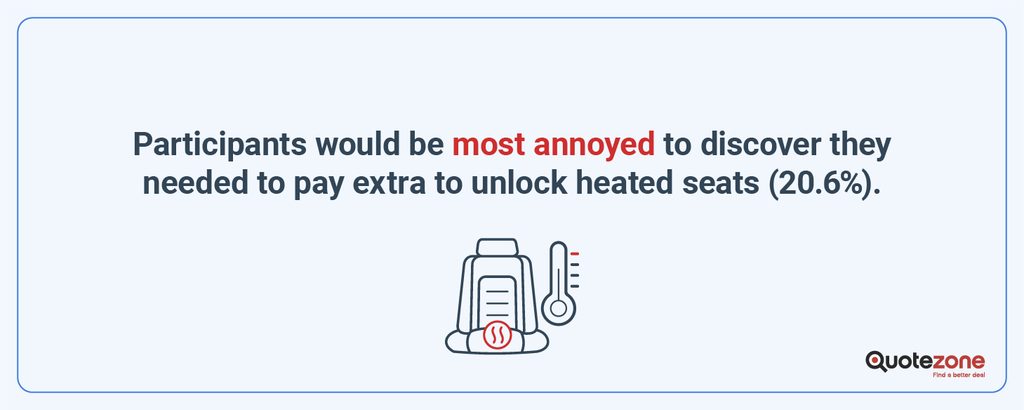
Among the features mentioned, heated seats were the top feature participants would be most annoyed to discover they needed to pay to unlock, selected by 20.6%. Women were also more frustrated by this than men (26.1% vs 13.6%).
Following this, 19.1% said that they’d be annoyed to find out any of the features mentioned would need payment to unlock.
One in ten (10.9%) said they’d be most frustrated to find out they needed to pay extra to unlock navigation services and just slightly less (10.8%) selected music or entertainment.
On the other hand, participants reported being less annoyed if they had to pay extra to unlock advanced vehicle information services (1.9%), extra EV charging or range-related services (2%) or live traffic announcements (2.4%).
How are additional charges affecting spending behaviour?
Earlier in the study, we revealed that over a third (34.3%) of participants would be much less likely to buy a car if they knew they would have to pay a monthly subscription to unlock features that hardware was already fitted for.
But when faced with two of the exact same cars, just with different subscription models, which one would participants choose to buy?
The survey put three scenarios in front of participants:
- Car A: £30,000 upfront, with all features included in the initial cost
- Car B: £28,000 upfront, plus £2,000 for feature subscriptions over five years for key features such as navigation, entertainment and advanced vehicle information
- Car B without subscriptions: £28,000 upfront, with no additional subscription costs and no access to the subscription based features such as navigation, entertainment and advanced vehicle information
The results show that almost half (49.5%) would choose Car A, paying an additional £2,000 upfront (making the total purchase price £30,000) to unlock all the features permanently and immediately. This option was by far the most popular among participants, showing that for consumers, knowing exactly what they get for their money when purchasing a new car is vital.
In comparison, 14.3% said they would prefer to buy Car B, paying £28,000 plus spending £2,000 for feature subscriptions over five years for key features such as navigation, entertainment and advanced vehicle information.
And 29.2% said they would prefer to buy Car B, but without paying for any additional subscriptions and therefore losing access to all unlockable features.
Just 7% said they had no preference.
By age, it’s perhaps unsurprising that the oldest generation in the study (those aged 55-64) were the most likely to opt for Car B, with no subscriptions and no access to additional technology or features, with 38.1% choosing this option, compared to just 15.9% of 18-24 year-olds.
The option to purchase Car B, with additional subscriptions for features and payments spread over five years, was most popular among the youngest generation in the study (aged 18-24), with 36.4% selecting this option, compared to just 10.3% of 55-64 year-olds.
This begs the question of whether the additional technology or features are seen as more important or desirable by the younger generations. With this in mind, we asked participants for their opinions on the growing use of technology in vehicles.
Almost two in five (38.8%) think car tech is dangerous
When asked their thoughts regarding the increasing use of touchscreens, alerts and other technology in modern cars, almost two in five (38.8%) think it can be dangerous because it takes attention away from the road. Women were more likely to agree to this than men with 42.8% of women saying they believed modern car technology to be dangerous, compared to 33.7% of men.
Following this, a third (33.3%) said they find it to be too distracting when driving.
And it appears these opinions hold worrying truth. Studies have shown that when interacting with touchscreens while driving, motorists’ reaction times can reduce by more than 50%. [11]
Despite this, 13.9% of our survey respondents said they think touchscreens and technology in cars actually makes them safer.

In addition to this, 26.2% said they think this new technology makes cars easier and more convenient to use, whereas 17.7% find them annoying or unnecessarily complicated and would prefer simpler controls.

It was the oldest generation in the study who found the most annoyance in new car tech, with over a quarter (27.5%) of this group agreeing with this statement, compared to just 13.6% of 18-24 year-olds.
| Rank | Opinions on modern car technology | Percentage of participants that agree |
| 1 | It can be dangerous because it takes attention away from the road | 38.8% |
| 2 | It’s too distracting when driving | 33.3% |
| 3 | It makes cars easier and more convenient to use | 26.2% |
| 4 | Find them annoying or unnecessarily complicated, and prefer simpler controls | 17.7% |
| 5 | It makes driving safer | 13.9% |
| 6 | Don’t have a strong opinion either way | 13.4% |
One in six (15%) have disabled a warning or alert in their car
The survey asked participants what their response would be if a car repeatedly warned or alerted them to something they considered unnecessary.
For one in six (15%), they admitted that they have already disabled a warning or alert, while a further 38.2% said they would disable it if they could.
Just 7.7% said they wouldn’t want to disable it, and a further 8.3% said they wouldn’t know how to disable it, even if they wanted to.
Just less than a fifth (19.5%) showed some concern about disabling warnings, and 16% said they would leave it, in case the warning was useful.
Over one in ten (11.5%) said they would put up with the alert or warning, even if they found it annoying.
| Rank | Response to a repeated alert or warning | Percentage of respondents |
| 1 | Would disable it if they could | 38.2% |
| 2 | Would be concerned about disabling a safety warning | 19.5% |
| 3 | Would leave it enabled in case the warning could be useful | 16.0% |
| 4 | Have disabled a warning like this before | 15.0% |
| 5 | Would put up with it, even if it was annoying | 11.5% |
| 6 | Not sure | 10.3% |
| 7 | Wouldn’t know how to disable it | 8.3% |
| 8 | Wouldn’t want to disable it | 7.7% |
Almost one in five (18.4%) would choose to revert back to traditional physical buttons
We asked participants what they would choose when it comes to the main features in their next car.
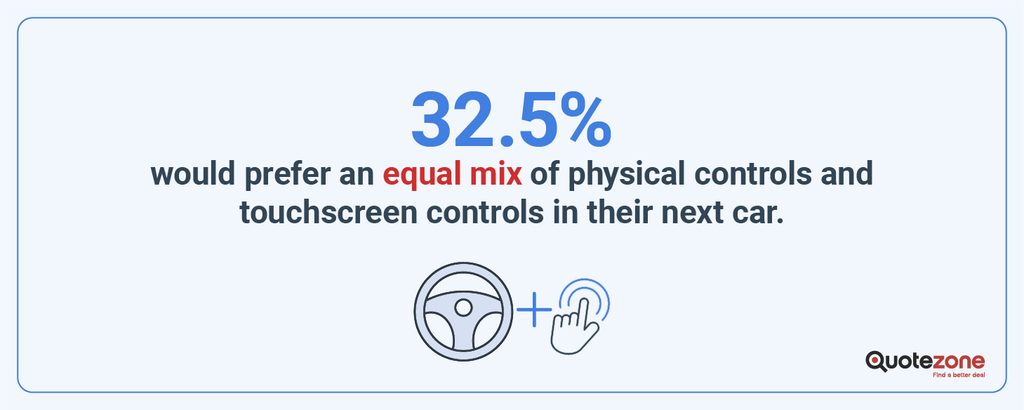
For the majority (32.5%), they would choose an equal mix of physical controls and touchscreen controls, whereas slightly more than a fifth (21.3%) would choose to have mostly physical controls, with a touchscreen for some features.
On the other hand, 18.4% said they would prefer their next car to feature all traditional physical buttons and switches. Perhaps unsurprisingly, this option was most popular among 55-64 year-olds with 23.1% opting for this, compared to 18.2% of 18-24 year-olds.
12.4% said they would prefer their next car to be mostly touchscreen controls, with physical controls for some key functions, and just 9.7% had no preference.
The smallest proportion of respondents (just 5.7%) said they would want their next car to be completely controlled through a touchscreen.
Methodology
The survey was conducted on behalf of Quotezone in September 2026 and asked 1,016 UK adults questions about modern technology in cars, and their opinions on subscription based models to unlock key in-car features.
Respondents were recruited online and screened to ensure a broad mix of demographic backgrounds. The survey provider is ISO-certified and carries out 11 trust verifications.
Sources
[1] Gov.uk, ‘Vehicle licensing statistics data tables’, 2026
[2] TSG Solutions, ‘The History of Electric Vehicles in the UK’, 2024
[3] Gov.uk, ‘Pathway for zero emission vehicle transition by 2035 becomes law’, 2024
[4] Car Leasing, ‘Can Cars Have WiFi?’
[5] Gadget Review, ‘BMW Kills Heated Seat Subscriptions But Doubles Down on Software Services’, 2026
[6] Ford, ‘Ford connectivity’
[7] Tesla, ‘Connectivity’
[8] Study UK, ‘Weather’
[9] Auto Express, ‘The last thing the car industry needs is in-car subscriptions’, 2025
[10] UK Parliament, ‘Digital Markets, Competition and Consumers Act 2024’, 2024
[11] Driving.org, ‘Safety experts warn modern car tech is increasing distraction and crash risk’, 2026
Photo credit – iStock.com teddyleung
This article is intended as generic information only and is not intended to apply to anybody’s specific circumstances, demands or needs. The views expressed are not intended to provide any financial service or to give any recommendation or advice. Products and services are only mentioned for illustrative rather than promotional purposes.