Does home insurance cover damage caused by Japanese knotweed?
22/07/2021



Reviewed by: Helen Rolph
Home, Travel & Pet Insurance Expert
Written by: Stephen Gamble
Insurance PR Writer
Fact-checked by: Quotezone Editorial Team
This content follows our Editorial Guidelines
Last Updated: 16 April 2026
Read time: 8 min
Japanese knotweed is a remarkably destructive plant when it invades a property – but is the resulting damage covered by your home insurance?
If, as a homeowner or landlord, you are thinking about potential threats to the structural integrity of your property, it’s fairly unlikely that garden weeds will be high on your list of concerns.
However, there is one particularly persistent and dangerous plant that all property owners need to keep an eye out for: Japanese knotweed.
Unidentified or left to grow unchecked, it can cause major damage to homes and create a serious financial headache for owners.
What is Japanese knotweed?
‘Fallopia japonica’, more commonly known as Japanese knotweed, is a fast-growing perennial plant with tall, dense stems. It recedes to ground level in the winter months but returns in spring and early summer, growing from stout stems that penetrate deep underground.
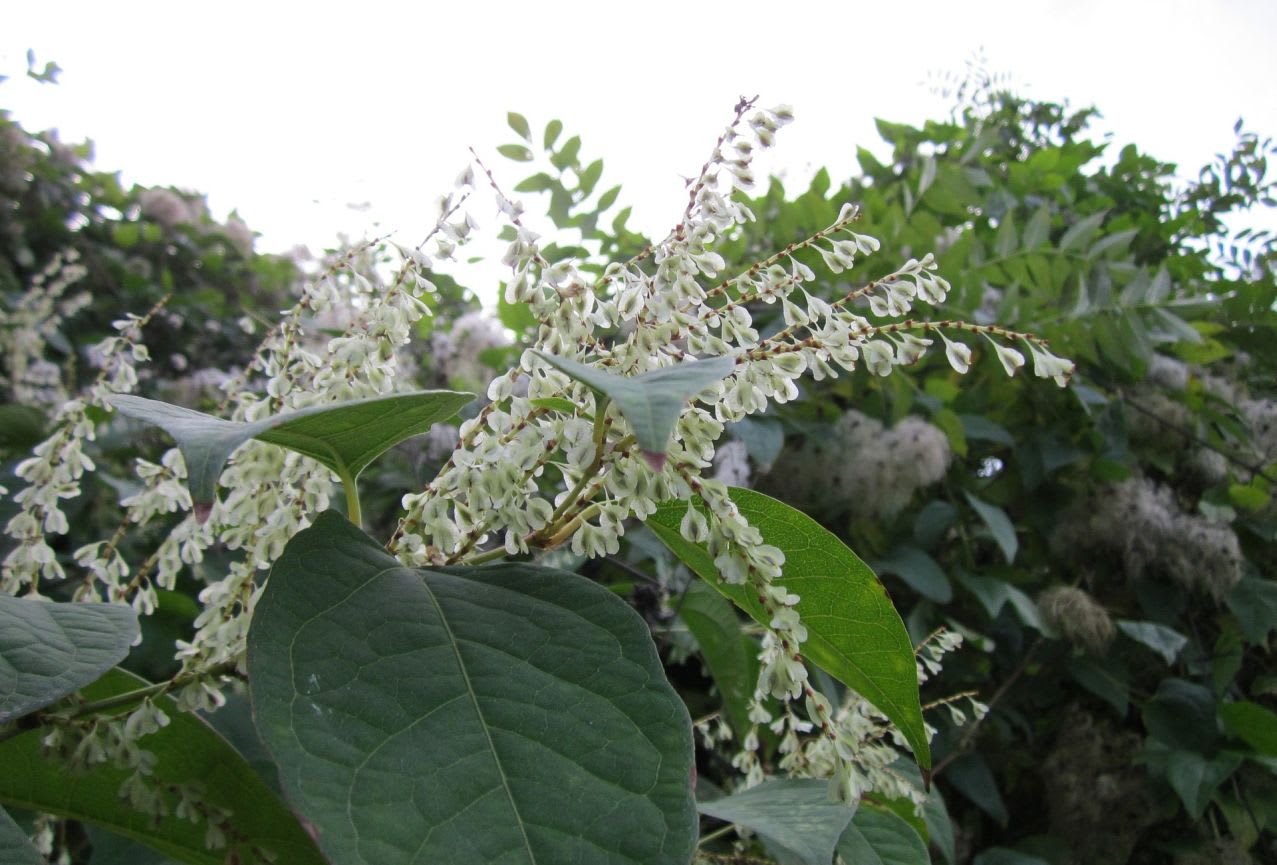
The plant can be identified by its reddish-purple shoots, which can grow rapidly in the summer months, developing into bamboo-like canes that can reach more than two metres in height. The canes have purple flecks and produce branches.It also has large heart-shaped leaves that can reach up to 14cm long. Creamy-white flowers appear in late summer and early autumn
It’s important the plant is identified properly, as it’s sometimes confused with other plants, such as Russian vine and Himalayan honeysuckle.
Is Japanese knotweed common in the UK?
Although it is much more prevalent in the USA and Asia, Japanese knotweed is a growing problem in many parts of the UK. There are no fungi or insects here that can control its growth, as there are in its native Japan.
In fact, the weed now affects approximately 1 million properties in the UK, knocking an estimated £20 billion off their combined value.
Given its rate of growth, the strength of its roots and how difficult it is to remove, the plant can pose a serious threat not only to garden paths, patios and drives, but also to sheds, greenhouses, garages and retaining walls. It can grow right through concrete and tarmac, potentially compromising the structural integrity and appearance of key parts of the property.
There have even been cases of Japanese knotweed growing into the foundations of people’s houses and appearing inside the home.
Is Japanese knotweed damage covered by buildings insurance?
If your property is affected by Japanese knotweed one of your first thoughts will be whether or not the cost of fixing any damage will be covered under your home insurance policy (or your landlord insurance if the property is a buy-to-let).
Unfortunately, the news usually isn’t good. Many home insurance providers impose clauses and exclusions in their buildings and contents insurance, landlord insurance, contents insurance and tenants insurance policies that mean policyholders usually won’t be covered for damage caused by Japanese knotweed, or for the cost of removing it.
Landlord liability insurance policies usually won’t cover it either, which means if it spreads from your property to a neighbouring property you probably wouldn’t be covered for any resulting liability claims.
However, while it usually isn’t covered as standard, it’s worth noting that some companies are beginning to offer specialist Japanese knotweed indemnity insurance, which can pay for professional treatment and removal of the plant if it is discovered. Cover can also extend to legal representation if a claim is made against the policyholder, possibly by neighbours whose properties are also being affected.
You aren’t necessarily obliged to tell your home insurance provider if you find Japanese knotweed, but you should answer honestly if they specifically ask you if the plant has appeared on your property. Furthermore, you are expected to do everything you can to prevent damage to your home.
We search up to 40 home insurance providers to save you hassle and money
Compare Home Insurance
We search up to 40 home insurance providers to save you hassle and money
What is a knotweed insurance-backed guarantee?
An insurance-backed guarantee (IBG) provides financial protection against the recurrence of Japanese knotweed after professional treatment has been carried out. If knotweed returns within the guarantee period, the IBG covers the cost of further remediation work.
Most IBGs are valid for 10 years and are issued by specialist knotweed treatment companies that follow the Property Care Association (PCA) code of practice. The guarantee is typically transferable to future owners of the property, which is why most mortgage lenders now require an IBG before they will approve a loan on an affected property.
The cost of an IBG is usually bundled into the overall treatment plan, which can range from £2,000 to £15,000 or more depending on the severity of the infestation and the size of the affected area. It is worth checking that any IBG you receive is underwritten by a regulated insurer, as not all guarantees carry the same level of protection.
How much does knotweed indemnity insurance cost?
Japanese knotweed indemnity insurance is a separate product from an IBG. While an IBG covers the cost of re-treatment if knotweed comes back, indemnity insurance covers the financial risk associated with knotweed being present on or near a property – for example, the potential cost of remediation or a reduction in property value.
Indemnity policies are typically purchased as a one-off premium rather than an annual renewal. Costs vary depending on the level of cover and the assessed risk, but policies generally range from £200 to £500 for residential properties. Some conveyancing solicitors arrange knotweed indemnity insurance as part of the property sale process, particularly when a RICS surveyor has identified knotweed risk nearby.
Indemnity insurance may be appropriate when knotweed has been identified within 7 metres of the property boundary but has not yet caused structural damage. If there is active knotweed on the property itself, a full treatment plan with an IBG is more likely to be required.
Can you get a mortgage with Japanese knotweed?
Japanese knotweed can make it significantly harder to secure a mortgage. Most mainstream lenders will decline a mortgage application if a RICS surveyor identifies knotweed within 7 metres of the property, unless a professional management plan is already in place and supported by an insurance-backed guarantee.
RICS categorises knotweed risk on a four-point scale. Category 1 (knotweed identified within the property boundary causing damage) is the most severe, while Category 4 (knotweed identified on neighbouring land but more than 7 metres from the property) is considered lower risk. Many lenders will accept a mortgage application for Category 3 or 4, but Categories 1 and 2 almost always require a treatment plan and IBG before approval.
Some specialist lenders and building societies may take a more flexible approach, particularly if a qualified surveyor confirms the knotweed is being actively managed. If you are buying a property and the survey reveals knotweed, you can use the issue as a negotiating point – asking the seller to arrange treatment and an IBG before completion, or reducing the asking price to reflect the remediation cost.
Removal costs for Japanese knotweed
Japanese knotweed has to be removed and disposed of in the right way in order to avoid it returning or laying down roots in another location. If you discover the plant on your property the best course of action is to hire a professional to get rid of it.
The cost of removing Japanese knotweed from a property varies, depending on the severity of the case, but can easily run into thousands of pounds. It’s estimated the UK as a whole spends approximately £150 million a year on efforts to control this problematic plant.
For homeowners, the cost of professional removal may be an acceptable one to bear, considering how big a financial impact Japanese knotweed can have if it’s left to continue growing.
The impact on mortgages and property values
One of the biggest financial considerations associated with Japanese knotweed is the impact it can have on the value of the property and its appeal to prospective buyers.
In one particularly extreme case reported by the BBC, a Hertfordshire couple were told the value of their new-build home had dropped by £250,000 after it was invaded by Japanese knotweed. The situation was so bad that three metres of soil needed to be removed from beneath the foundations of the house in order to remove the plant.
It’s not uncommon for lenders to refuse mortgages on buildings that are affected by Japanese knotweed, or at least insist a professional is brought in to resolve the problem before a loan can be granted.
You might also need
If you own a property affected by Japanese knotweed, you may also want to review your wider insurance cover. Non-standard home insurance is designed for properties that fall outside the criteria of a standard policy – including those with known subsidence risk, unusual construction, or existing pest issues such as knotweed.
You should also check that your buildings insurance provides adequate cover for the structural elements of your home, particularly if knotweed has been identified near the foundations, drains or boundary walls.
Ready to review your home insurance? Compare home insurance quotes on Quotezone to search policies from up to 40 UK providers in minutes.
This article is intended as generic information only and is not intended to apply to anybody’s specific circumstances, demands or needs. The views expressed are not intended to provide any financial service or to give any recommendation or advice. Products and services are only mentioned for illustrative rather than promotional purposes.