Pickpocket statistics
28/10/2026




Reviewed by: Helen Rolph
Home, Travel & Pet Insurance Expert
Written by: Katie Gawley
Insurance Content Writer
Fact-checked by: Quotezone Editorial Team
This content follows our Editorial Guidelines
Last Updated: October 2026
Read time: 10 min
Pickpocket Statistics
Europe welcomed 793 million international tourists in 2025, more than half of all international arrivals worldwide. It’s also rated the world’s safest region by long-haul travellers, and 44% cite safety as a key factor when choosing a European destination. [1][2]
Despite this, the crowds that make Europe’s landmarks so popular can also make them the ideal hunting ground for pickpockets, and it’s a risk holidaymakers are afraid of, with nearly nine in ten UK travellers afraid of being pickpocketed while abroad.
In October 2026, we created the Quotezone European Pickpocket Index to show where holidaymakers need to be most careful. We analysed visitor reviews of the most popular attractions in 47 countries across Europe for mentions of pickpockets, thieves, scams and other theft-related terms.
Key statistics
- Italy is the most pickpocketed country in Europe, according to our European Pickpocket Index, scoring 32.2%. Czechia (20.3%), Spain (15.1%) and France (12.2%) follow.
- Czechia is Europe’s most pickpocketed country per visitor, with 5.5 pickpocket mentions for every 100,000 visitors, well ahead of Italy (1.4).
- Latvia, Estonia and Denmark all enter the top 10 when pickpocketing is measured per visitor.
- Rome’s Trevi Fountain is Europe’s most pickpocketed landmark, with 1,000 pickpocket mentions in visitor reviews, ahead of Prague’s Charles Bridge (687).
- Prague’s Old Town Square, Rome’s Colosseum and Paris’ Musée d’Orsay complete the top five most pickpocketed landmarks, with 421, 393 and 359 pickpocket mentions respectively.
- Barcelona has two landmarks in Europe’s top 10 for pickpocketing, and the city recorded around 239 thefts a day in 2025, according to police figures.
- Scams are the most mentioned crime after pickpocketing, with 1,544 mentions across Europe, and Italy accounts for the most (501).
- British nationals were issued almost 15,000 emergency travel documents in Europe in 2024 after passports were lost, stolen or damaged, with Spain (5,354) accounting for the most, according to the Foreign, Commonwealth & Development Office.
Most pickpocketed countries in Europe
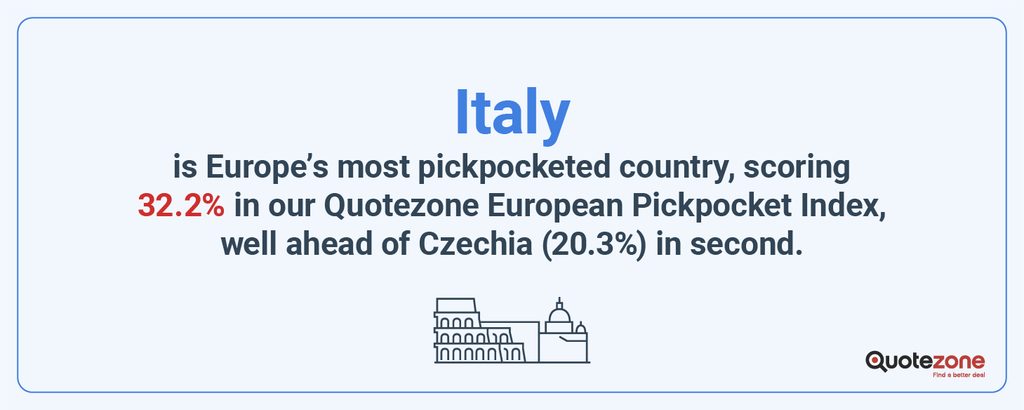
Italy is the most pickpocketed country, scoring 32.2%, higher than any other country in Europe. This is despite reported pickpocketing thefts falling by 6% across the country in 2025. [3]
To build the index, we used semantic analysis on online visitor reviews of the most popular attractions in 47 countries across Europe, flagging mentions of pickpockets and ranking each country by its score.
Italy is followed by Czechia (20.3%), Spain (15.1%) and France (12.2%), showing how prevalent pickpocketing is when travelling to Italy. These three countries are well ahead of the rest of the top 10, with Portugal the next highest at 4%.
The mentions per 100,000 visitors column also shows how the picture can change when visitor numbers are taken into account.
| Europe’s biggest pickpocket countries | |||
|---|---|---|---|
| Rank | Country | Mentions per 100,000 visitors | Percentage score |
| 1 | Italy | 1.4 | 32.2% |
| 2 | Czechia | 5.5 | 20.3% |
| 3 | Spain | 0.6 | 15.1% |
| 4 | France | 0.4 | 12.2% |
| 5 | Portugal | 0.8 | 4% |
| 6 | Netherlands | 0.4 | 3.4% |
| 7 | Germany | 0.1 | 3.0% |
| 8 | Greece | 0.5 | 2.8% |
| =9 | Austria | 0.1 | 0.9% |
| =9 | Sweden | 0.1 | 0.9% |
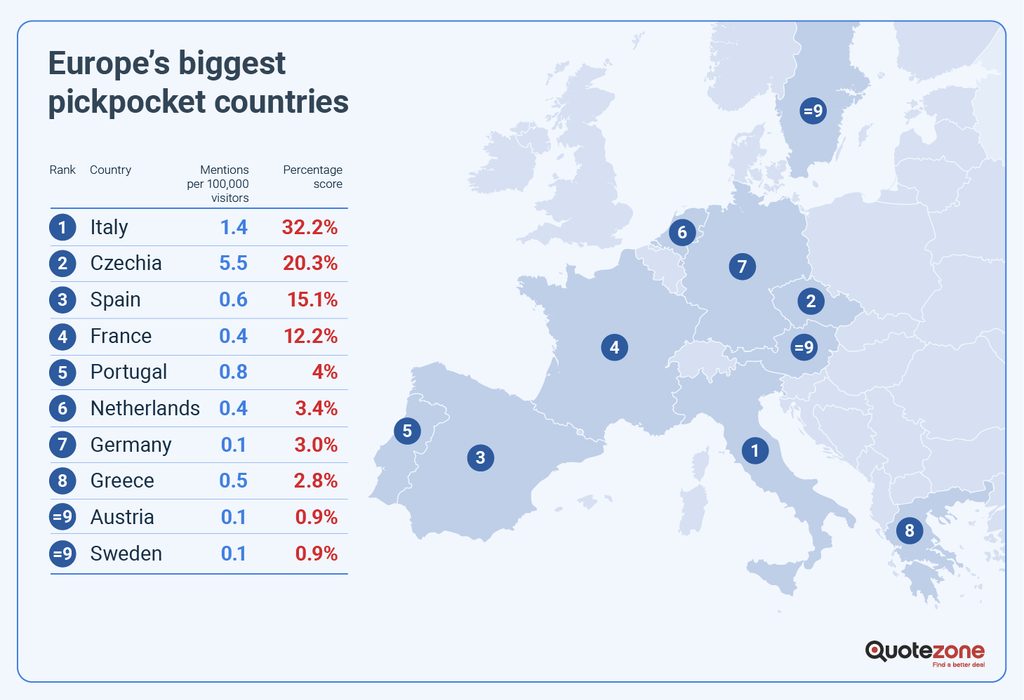
Source: [4]
Pickpocketing rates by visitor numbers
Czechia is Europe’s most pickpocketed country per visitor, with 5.5 pickpocket mentions for every 100,000 visitors according to our research.
We measured this by comparing pickpocket mentions in each country with its total visitor numbers, so smaller, less-visited destinations could be compared with Europe’s busiest ones.
Italy still ranks highly in second, with 1.4 pickpocket mentions for every 100,000 visitors. Latvia (0.9), Portugal (0.8), Spain (0.6) and Estonia (0.6) complete the top five, with Spain and Estonia joint fifth.
Measuring pickpocketing per visitor brings three new countries into the top 10: Latvia (3rd), Estonia (joint 5th) and Denmark (joint 8th). [4]
| Countries with the most pickpockets per 100,000 visitors | ||
|---|---|---|
| Rank | Country | Mentions per 100,000 visitors |
| 1 | Czechia | 5.5 |
| 2 | Italy | 1.4 |
| 3 | Latvia | 0.9 |
| 4 | Portugal | 0.8 |
| =5 | Spain | 0.6 |
| =5 | Estonia | 0.6 |
| 7 | Greece | 0.5 |
| =8 | Denmark | 0.4 |
| =8 | Netherlands | 0.4 |
| =8 | France | 0.4 |
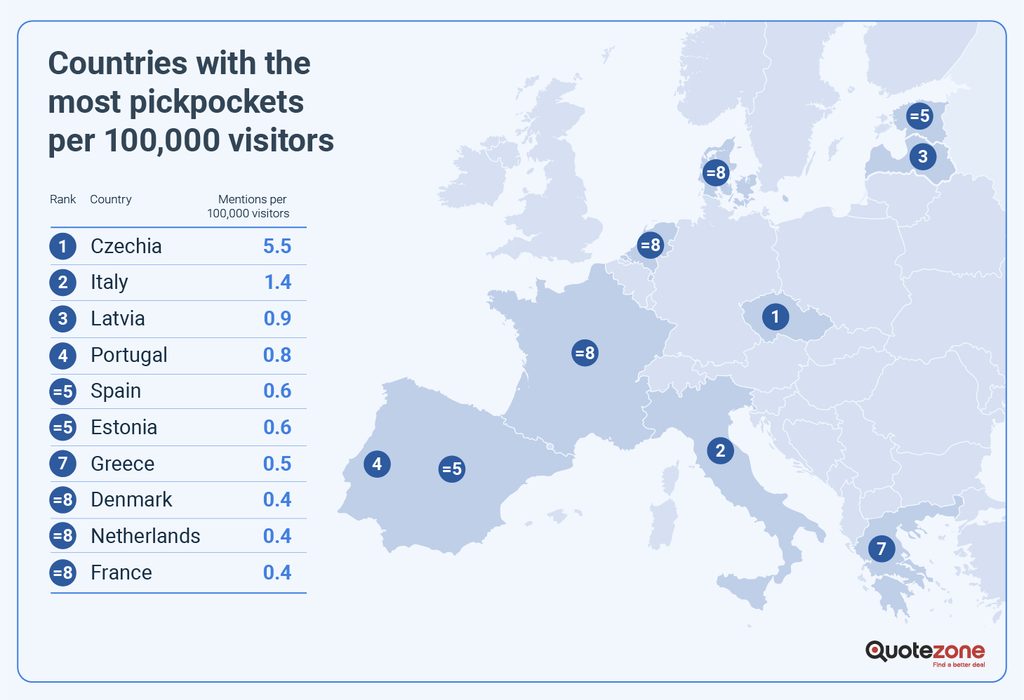
Source: [4]
Landmarks being targeted by pickpockets
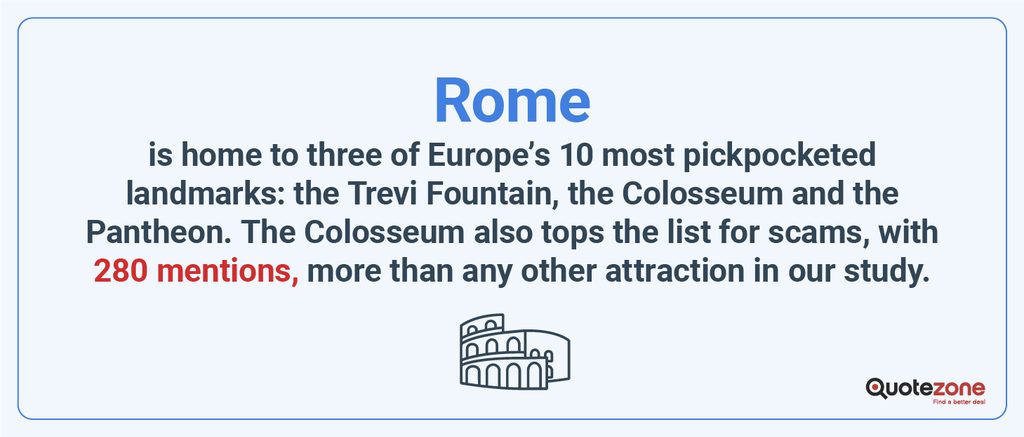
Rome’s Trevi Fountain is the most pickpocketed landmark in Europe, with 1,000 pickpocket mentions in visitor reviews. Prague’s Charles Bridge comes second with 687 mentions, followed by the city’s Old Town Square with 421.
Rome has three landmarks in the top 10, more than any other city, with the Colosseum (393) and the Pantheon (211) joining the Trevi Fountain. The Colosseum also ranks as the second landmark overall for theft-related mentions (835), behind only the Trevi Fountain (1,245), and tops the list for scams (280), robbery (38), con artists (35) and fraud (18).
Prague, Paris and Barcelona each have two landmarks in the top 10. The common thread is crowds: busy squares, packed bridges and popular museums give pickpockets plenty of cover and plenty of distracted visitors to target. In Barcelona, police figures back this up, recording around 239 thefts a day in 2025, equivalent to 10 every hour. Over a third (36.4%) took place on the street and a fifth (20%) on public transport, both prime territory for pickpockets. [5]
| Most pickpocketed European landmarks | ||||
|---|---|---|---|---|
| Rank | Landmark | City | Country | Pickpocket mentions |
| 1 | Trevi Fountain | Rome | Italy | 1,000 |
| 2 | Charles Bridge | Prague | Czechia | 687 |
| 3 | Old Town Square | Prague | Czechia | 421 |
| 4 | Colosseum | Rome | Italy | 393 |
| 5 | Musée d’Orsay | Paris | France | 359 |
| 6 | Gothic Quarter | Barcelona | Spain | 268 |
| =7 | Louvre Museum | Paris | France | 239 |
| =7 | Sagrada Familia | Barcelona | Spain | 239 |
| 9 | Pantheon | Rome | Italy | 211 |
| 10 | Red Light District | Amsterdam | Netherlands | 172 |
Most common theft type by country
Pickpocketing isn’t the only threat tourists mention in their reviews, with many travellers also mentioning scams, thieves, robbery, muggings and con artists.
Here’s a breakdown of each theft-related term, showing the total number of mentions and the country that ranked highest for each:
| Most common theft types by country | ||
|---|---|---|
| Crime | Total mentions | Country with most mentions |
| Scams | 1,544 | Italy (501) |
| Thieves | 811 | Italy (213) |
| Robbery | 400 | Italy (92) |
| Muggings | 174 | Netherlands (32) |
| Con artists | 156 | Italy (70) |
| Fraud | 136 | Italy (27) |
Scams
Scams are the most mentioned crime after pickpocketing. Italy leads by a wide margin, with France (190), Spain (162) and Czechia (116) making up the rest of the top four.
Thieves
Mentions of thieves follow a similar pattern to pickpocketing, with Spain (143), France (90) and Czechia (71) trailing Italy.
Robbery
Spain (50) and the United Kingdom (45) rank second and third for robbery mentions.
Muggings
Muggings are the one category Italy doesn’t lead. The Netherlands tops the list, ahead of France (22), Italy (19) and the United Kingdom (18). The UK government travel advice reflects this, warning that bag-snatching is common in the Netherlands, particularly in central Amsterdam, with thieves operating in gangs on trains and trams. [6]
Con artists and fraud
Con artists and fraud are mentioned less often, and Italy leads both. France (22) and Czechia (18) follow for con artists, while Spain (18) and Portugal (12) follow for fraud.
How to protect yourself when travelling
Losing your passport abroad, whether it’s stolen, lost or damaged, can quickly derail a trip. It isn’t strictly a pickpocketing statistic, but it shows how often British holidaymakers lose one of their most important belongings, and why keeping valuables secure should be taken seriously. In 2024, British nationals were issued almost 15,000 emergency travel documents in Europe, more than half of all those issued worldwide. Holidaymakers in Spain (5,354) needed the most, followed by Italy (1,541) and France (1,517)[7]
Taking a few simple precautions can make a big difference, both to keeping your belongings safe and to making sure you’re covered if the worst happens.
Greg Wilson, Founder and CEO of Quotezone.co.uk, said that unfortunately this new research shows that thousands of people have complained about pickpockets in Europe while experiencing the best that European holiday destinations have to offer. He said: “Theft can happen anywhere and tourist hotspots are convenient places for criminals to target holidaymakers’ wallets and purses while they are busy taking in the sights.
“Iconic attractions like the Trevi Fountain in Rome and the Charles Bridge in Prague are particularly popular with pickpockets as they can move more inconspicuously amongst larger crowds.
“Many holidaymakers are unaware that some of the most popular destinations for Brits rank among the worst in Europe for pickpocketing.
“Our research revealed some surprising results. While Italy has the most pickpocketing mentions overall, we also took the number of visitors into account in a separate ranking, and Czechia has the highest rate per 100,000 visitors, well ahead of much busier destinations.
“It’s essential to remain vigilant – leave valuables, like expensive jewellery, in a safe in the hotel and always travel with a secure cross-body bag with zips or even a money belt, to protect phones and wallets.
“Try never to leave personal belongings unattended because travel insurance companies require travellers to take ‘reasonable care’ and could reject insurance claims for theft if items have been left alone.
“It’s also important for travellers to remember to get a police report for the loss or theft of an item if they’ve been pickpocketed, as this will support the insurance claim. Double-checking what is and isn’t covered on the travel insurance policy before heading to these high-ranking destinations is key; most travel insurance policies cover important documentation such as passports but rarely cover stolen cash and phones. Most providers allow travellers to add on extras that might be needed, such as gadget travel insurance.”
Methodology
This research updates our original 2024 study with fresh data, an expanded set of countries and new measures. In October 2026, we analysed 47 countries across Europe to create the Quotezone European Pickpocket Index. This includes transcontinental countries such as Turkey, Georgia, Armenia and Azerbaijan, as well as Cyprus and Kosovo. Russia, Ukraine and Vatican City were not included. For each country, we looked at the three most populated cities and the five most popular attractions in each of those cities. Review data was unavailable for one city, Sumqayit in Azerbaijan, giving 700 attractions in total.
All review data was taken from a leading online review platform. Using semantic analysis, we searched visitor reviews of these attractions, which have more than 4.6 million reviews between them, for mentions of pickpockets, along with other theft-related terms including thieves, scams, robbery, con artists, muggings and fraud. In total, we found 8,915 theft-related mentions, 5,676 of which mentioned pickpockets. Each country’s score is its percentage of all 5,676 pickpocket mentions recorded across the 47 countries, which we used to rank the top 10. Burglary and embezzlement were also searched for but returned too few mentions to include in the breakdown.
We also created a separate ranking of mentions per 100,000 visitors, comparing each country’s pickpocket mentions with its total number of international and domestic visitors in 2025 where available, based on Eurostat data on arrivals at tourist accommodation, so smaller, less-visited countries can be compared alongside the busiest ones.
Landmarks were ranked by the number of pickpocket mentions specifically, while the breakdown of crime types, such as scams, robbery and muggings, was ranked by the total number of mentions for each term. Figures are rounded to one decimal place, and countries with the same rounded figure share a ranking.
Sources
- Hospitality Net. International tourist arrivals up 4% in 2025 reflecting strong travel demand around the world, https://www.hospitalitynet.org/news/4130515.html
- European Travel Commission. Europe ranks as the safest global destination, while cost pressures shape long-haul travel plans, https://etc-corporate.org/news/europe-ranks-as-the-safest-global-destination/
- L’Unione Sarda. Oristano (again) the safest province in Italy, https://www.unionesarda.it/en/sardinia/oristano-again-the-safest-province-in-italy-other-sardinian-cities-also-doing-well-crime-rates-are-decreasing-yjz51wgp
- Eurostat. Arrivals at tourist accommodation establishments, https://ec.europa.eu/eurostat/databrowser/view/tour_occ_arnraw/default/table?lang=en
- Ara. Security in Barcelona: thefts haven’t been this low since 2015, https://en.ara.cat/society/security-in-barcelona-thefts-haven-t-been-this-low-since_1_5647693.amp.html
- Foreign, Commonwealth & Development Office. Netherlands travel advice: safety and security, https://www.gov.uk/foreign-travel-advice/netherlands/safety-and-security
- Foreign, Commonwealth & Development Office. Foreign, Commonwealth & Development Office consular data 2024, https://www.gov.uk/government/publications/foreign-commonwealth-and-development-office-consular-data-2024
Photo credit – iStock.com Prostock-Studio
This article is intended as generic information only and is not intended to apply to anybody’s specific circumstances, demands or needs. The views expressed are not intended to provide any financial service or to give any recommendation or advice. Products and services are only mentioned for illustrative rather than promotional purposes.